Medical Waste Management: 2026 Regulatory Updates and Compliance Best Practices
Healthcare facilities across the United States are navigating a rapidly evolving landscape of medical waste regulations. From state-level overhauls to federal rule adoptions, the requirements for proper medical waste handling have never been more complex.
Medical Waste Management: 2026 Regulatory Updates and Compliance Best Practices
Introduction
Healthcare facilities across the United States are navigating a rapidly evolving landscape of medical waste regulations. From state-level overhauls to federal rule adoptions, the requirements for proper medical waste handling have never been more complex—or the stakes higher. In 2025 alone, major healthcare organizations faced multi-million dollar penalties for improper waste disposal, while states like California, Alabama, and Tennessee enacted sweeping changes to their regulatory frameworks.
For environmental services teams and facility managers, staying current with these changes is essential. Medical waste management is no longer simply an operational concern—it is a compliance priority with significant financial and legal implications. This guide covers the key regulatory developments of 2025-2026 and provides practical steps your facility can take to maintain compliance.
Understanding Medical Waste Categories
Types of Regulated Medical Waste
Medical waste, also known as regulated medical waste (RMW), requires special handling and disposal procedures. The Environmental Protection Agency estimates that approximately 15% of healthcare waste is hazardous, with the remainder classified as non-hazardous but still requiring proper management.
The primary categories include:
Biohazardous Waste: Materials contaminated with blood or other potentially infectious materials, including used gloves, gauze, and discarded sharps. These materials pose the greatest risk for disease transmission and require the most stringent handling protocols.
Sharps Waste: Needles, syringes, lancets, and other sharp objects capable of causing punctures or cuts. Sharps injuries remain a significant concern for healthcare workers, waste handlers, and the public, with an average of 3.6 injuries per 100 employees in healthcare settings.
Pharmaceutical Waste: Both hazardous and non-hazardous medications that must be disposed of properly to prevent environmental contamination. The EPA's Hazardous Waste Pharmaceuticals Rule has significantly tightened requirements for how healthcare facilities manage unused or expired medications.
Trace Chemotherapy Waste: Materials that have contacted chemotherapy agents but contain no free liquid, such as empty vials, gloves, and packaging. These require separate disposal pathways from other pharmaceutical waste.
Key Regulatory Developments for 2025-2026
EPA Hazardous Waste Pharmaceuticals Rule Adoption
The EPA's Hazardous Waste Pharmaceuticals Rule (Subpart P) gained significant momentum in 2025, with Maryland, Michigan, and Missouri adopting the full rule. This regulation prohibits flushing hazardous pharmaceutical waste down drains—a practice that contributed to pharmaceutical contamination of water supplies and the development of antibiotic-resistant bacteria.
For healthcare facilities, the rule establishes more stringent management requirements for hazardous pharmaceuticals, including proper categorization, storage, and disposal through permitted treatment facilities. Facilities in states that have adopted Subpart P must ensure their waste management contracts and internal protocols align with these requirements.
State Regulatory Overhauls
California led the nation in medical waste regulatory changes during 2025, with a comprehensive overhaul that included multi-million dollar enforcement actions. The state expanded its Pharmaceutical and Sharps Waste Stewardship Program and introduced new simplified waste classifications designed to make compliance more manageable for smaller facilities. Notably, the California Department of Toxic Substances Control began rolling out revised hazardous waste classification guidelines, with annual electronic verification requirements due each March.
Alabama completed a two-phase regulatory update in 2025, introducing updated waste classification systems, revised storage and packaging requirements, and new registration and permitting processes. Facilities operating in Alabama must ensure their permits are current and their staff are trained on the new classification categories.
Tennessee revised its definition of medical waste in July 2025, providing clearer boundaries for what constitutes regulated medical waste versus general waste. This change affects segregation protocols and disposal contracts for facilities across the state.
OSHA Compliance Updates
Healthcare facilities face increased financial consequences for OSHA violations in 2025. Penalty costs rose to $16,550 per serious violation and up to $165,514 for willful or repeated violations. For medical waste management, this means that improper handling of biohazardous materials, inadequate sharps disposal programs, and failure to maintain required documentation can result in substantial financial penalties.
The Occupational Safety and Health Administration continues to emphasize the intersection of medical waste handling and worker safety. Proper segregation at the point of generation, use of approved sharps containers, and comprehensive training programs are essential for avoiding citations.
Best Practices for Medical Waste Segregation
Color-Coding Systems
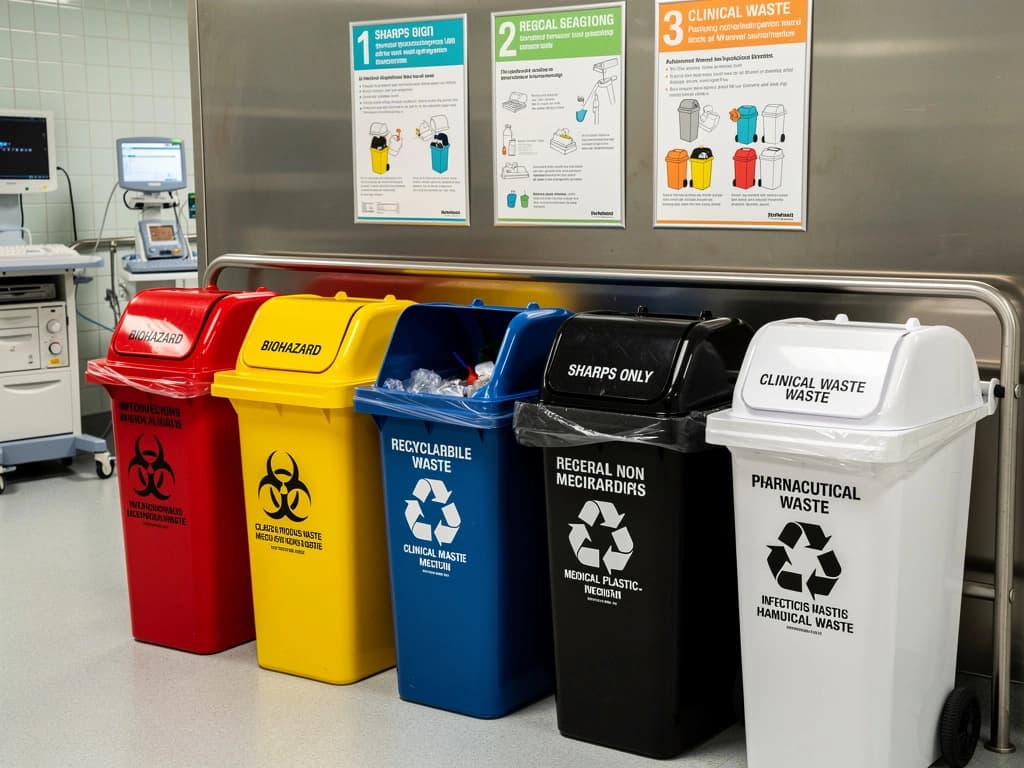
Effective medical waste segregation begins with clearly labeled, color-coded containers that meet regulatory requirements. The standard color coding includes:
Red containers are designated for biohazardous waste and sharps, while yellow containers hold trace chemotherapy waste. Non-hazardous pharmaceutical waste typically goes into blue or white containers, with black containers reserved for hazardous pharmaceuticals. General waste that does not meet any regulated category should be disposed of in standard grey containers.
The critical principle is segregation at the source—beginning immediately at the point of generation to reduce contamination risk and simplify downstream handling. Once waste streams are mixed, separating them becomes difficult, costly, and sometimes impossible.
Point-of-Generation Segregation
Healthcare workers must have access to appropriate containers at every location where regulated waste is generated. Exam rooms, procedure areas, patient rooms, and nursing stations all require properly positioned containers with clear labeling.
Staff training should emphasize the consequences of improper segregation. When non-hazardous waste enters the biohazard stream, disposal costs increase significantly. When biohazardous materials contaminate general waste, facilities face potential regulatory citations and environmental liability.
Documentation and Tracking
Comprehensive documentation transforms medical waste management from an invisible process into a measurable, accountable system. Waste manifests should capture the types and quantities of waste generated, the date of disposal, the treatment method employed, and the responsible staff member.
Modern facilities increasingly adopt electronic tracking systems that provide real-time visibility into waste volumes and disposal patterns. These systems generate audit-ready records that demonstrate compliance during regulatory inspections and enable facilities to identify cost-saving opportunities.
Technology and Innovation in Waste Management
Smart Container Systems
Advances in waste management technology are improving safety and efficiency for healthcare facilities. Smart container systems offer hands-free disposal, automatic fill-level alerts, and tamper-evident features that reduce worker exposure to biohazardous materials and prevent overfilling.
Systems like the NeedleDrop have demonstrated an 87% reduction in sharps injuries in six-year studies, while robotic washline technologies enhance container hygiene and extend the useful life of reusable containment systems.
Electronic Manifesting
The healthcare industry is moving toward mandatory electronic manifesting (e-Manifest) systems that replace paper-based documentation with real-time cloud-based tracking. By late 2026, many jurisdictions are expected to require electronic reporting, giving facilities greater visibility into their waste streams and regulators better oversight of disposal pathways.
Facilities should begin preparing for e-Manifest adoption by ensuring their waste management vendors offer compatible systems and their internal documentation processes can integrate with electronic platforms.
Treatment Technologies
Alternative treatment technologies are evolving in response to stricter air emission standards for medical waste incineration. Thermal treatment through microwave systems, steam sterilization via autoclaving, and emerging technologies like pyrolysis and gasification offer more environmentally sustainable options for rendering medical waste non-infectious.
For facilities evaluating treatment options, the choice of technology affects not only regulatory compliance but also operational costs and environmental footprint.
Protecting Workers and Patients
Sharps Injury Prevention
Needlestick and sharps injuries remain one of the most significant occupational hazards in healthcare settings. Beyond the immediate physical injury, these incidents carry risk of transmission for bloodborne pathogens including HIV, Hepatitis B, and Hepatitis C.
A comprehensive sharps injury prevention program includes engineering controls like safety-engineered sharps devices, administrative controls such as proper disposal container placement, and ongoing staff training on handling and disposal procedures.
Connection to Infection Prevention
Proper medical waste management is integral to broader infection prevention efforts. When waste is handled incorrectly, pathogens can escape the healthcare environment and threaten patients, staff, and the community. Research demonstrates that facilities with robust waste management programs experience lower rates of healthcare-associated infections.
Environmental services teams play a critical role in this prevention chain. Their attention to proper segregation, container placement, and documentation directly impacts the facility's ability to protect everyone who passes through its doors.
Conclusion
The medical waste management landscape continues to evolve rapidly, with regulatory changes at both federal and state levels demanding increased attention from healthcare facilities. The financial consequences of non-compliance—exemplified by recent multi-million dollar settlements—underscore the importance of treating waste management as a serious compliance priority.
Healthcare facilities that invest in proper segregation systems, staff training, documentation protocols, and modern tracking technologies position themselves for compliance success. More importantly, these investments protect the workers who handle dangerous materials every day and the patients who trust facilities to maintain safe, clean environments.
The question is no longer whether your facility can afford to prioritize medical waste compliance. The consequences of inaction make that calculation clear. The time to audit your protocols, update your training, and verify your vendor relationships is now.
More Stories
Healthcare Facility Cleaning Standards: 2026 Compliance and Best Practices Guide
Healthcare-associated infections (HAIs) remain one of the most pressing challenges facing medical facilities, contributing to approximately 1.7 million
Risk-Based Environmental Cleaning: A Practical Guide for Healthcare Facilities
The CDC's risk-based approach to environmental cleaning provides healthcare facilities with a systematic framework that considers the probability of contamination, patient vulnerability, and potential for exposure.