
Risk-Based Environmental Cleaning: A Practical Guide for Healthcare Facilities
The CDC's risk-based approach to environmental cleaning provides healthcare facilities with a systematic framework that considers the probability of contamination, patient vulnerability, and potential for exposure.
Risk-Based Environmental Cleaning: A Practical Guide for Healthcare Facilities
Introduction
Healthcare-associated infections remain one of the most persistent challenges facing facilities today. The Centers for Disease Control and Prevention estimates that approximately one in 31 hospital patients has at least one healthcare-associated infection on any given day. While clinical interventions receive significant attention, the role of environmental cleaning in infection prevention is equally critical.
The CDC's risk-based approach to environmental cleaning provides healthcare facilities with a systematic framework that considers the probability of contamination, patient vulnerability, and potential for exposure. This approach moves beyond the one-size-fits-all methodology, instead tailoring cleaning frequency, methods, and product selection to the specific risk profile of each area within a facility.
For healthcare administrators and environmental services managers, implementing a risk-based cleaning strategy means better resource allocation, improved infection prevention outcomes, and stronger compliance documentation. This guide breaks down the key principles and practical steps for adopting this evidence-based approach.
Understanding Risk Categories in Healthcare Settings
High-Risk Areas
High-risk areas within a healthcare facility demand the most stringent cleaning protocols. These spaces include surgical suites, intensive care units, burn units, and oncology departments where patients have compromised immune systems and the potential for infection is greatest.
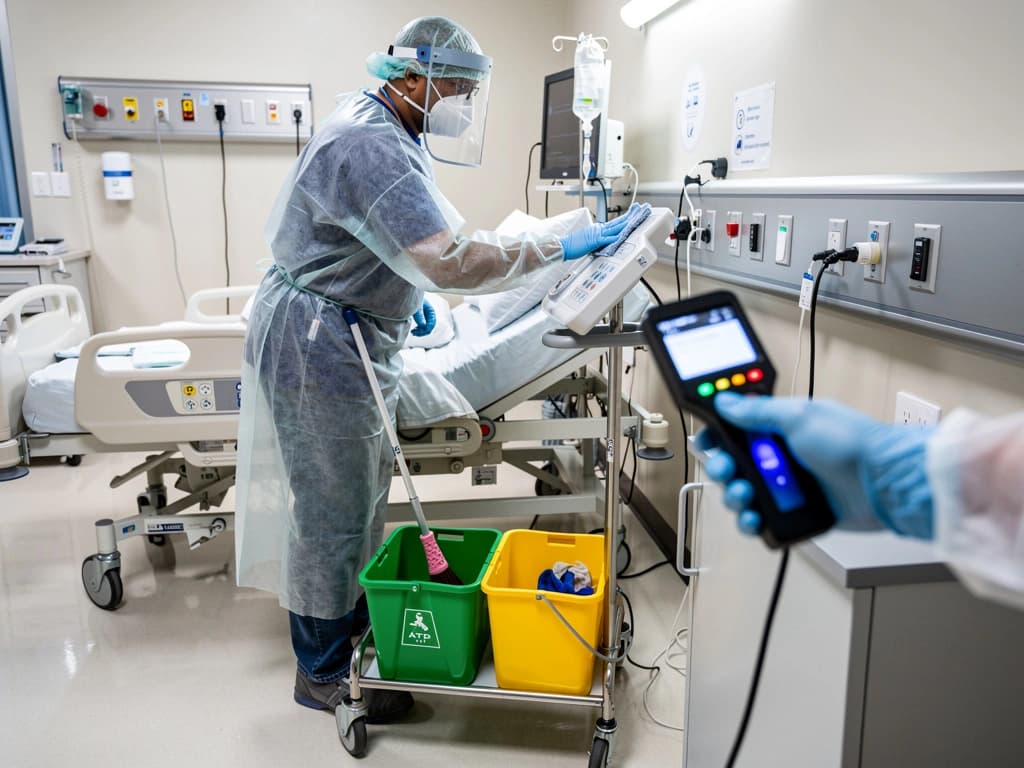
In these environments, cleaning staff must use hospital-grade disinfectants with proven efficacy against a broad spectrum of pathogens. Contact times must be strictly observed, and verification protocols should include regular ATP bioluminescence testing or fluorescent marker programs. High-risk areas typically require cleaning after each patient discharge, in addition to daily terminal cleaning, and may demand twice-daily disinfection of high-touch surfaces.
Moderate-Risk Areas
Emergency departments, general medical floors, and dialysis units fall into the moderate-risk category. Patients in these areas may have varying levels of immune function, and the turnover rate creates consistent opportunities for pathogen transmission.
Moderate-risk areas benefit from a structured cleaning schedule that prioritizes high-touch surfaces while maintaining thorough routine cleaning protocols. The focus shifts slightly from extreme pathogen elimination to sustainable, consistent practices that prevent buildup of contaminants over time.
Low-Risk Areas
Administrative offices, hallways, and storage areas present lower transmission risks but still require regular maintenance cleaning. While these areas may not need the same frequency of disinfection, maintaining cleanliness standards throughout a facility supports an overall culture of hygiene and prevents cross-contamination when staff move between areas.
The Evidence-Based Cleaning Pattern
Top-to-Bottom, Clean-to-Dirty
One of the fundamental principles of risk-based cleaning is the top-to-bottom, clean-to-dirty methodology. This approach prevents recontamination of cleaned surfaces by ensuring that staff work from the highest points in a room downward and from the cleanest areas toward potentially dirtier zones.
When cleaning a patient room, staff should begin with overhead lights, then move to surfaces like bedside tables and bed rails before addressing flooring. This sequence ensures that any particles dislodged during cleaning fall onto surfaces that have not yet been addressed, avoiding the need to re-clean already-treated areas.
Systematic Movement Patterns
Consistent movement patterns improve cleaning thoroughness while increasing efficiency. Common approaches include left-to-right or clockwise patterns that ensure no area is accidentally skipped. These systematic movements should be incorporated into staff training and reinforced through regular competency verification.
Two-Bucket System
The two-bucket system separates clean and dirty solutions, preventing the spread of contaminants. One bucket contains fresh cleaning solution while the other collects dirty water. This simple practice dramatically reduces cross-contamination between surfaces and room areas.
High-Touch Surface Prioritization
High-touch surfaces represent the most critical focus areas within any healthcare environment. These surfaces include bed rails, IV poles, sink handles, call bells, doorknobs, light switches, and remote controls. The CDC estimates that pathogens can survive on surfaces for extended periods, making regular disinfection of high-touch areas essential for breaking transmission chains.
Environmental services teams should receive specific training on identifying and prioritizing high-touch surfaces in each room type. Checklists that highlight these critical points ensure consistency across staff members and shifts. During peak illness seasons, such as flu season or respiratory infection outbreaks, increasing the frequency of high-touch surface disinfection provides an additional layer of patient protection.
Documentation and Accountability
Cleaning Logs and Verification
Documentation transforms cleaning from an invisible activity into a measurable, accountable process. Comprehensive cleaning logs should capture the areas serviced, time of cleaning, products used, and the staff member responsible. This documentation serves multiple purposes: it provides evidence during regulatory surveys, enables quality improvement analysis, and creates accountability among cleaning staff.
Modern healthcare facilities increasingly adopt electronic documentation systems that timestamp activities and require staff verification. These systems generate reports that can identify patterns, such as consistently missed areas or times when cleaning protocols are rushed.
Outcome-Based Metrics
Moving beyond tracking whether cleaning occurred to measuring how effectively it was performed represents a significant advancement in environmental services quality assurance. ATP bioluminescence testing measures the amount of adenosine triphosphate present on surfaces, providing an objective measure of cleanliness. Fluorescent marker programs apply invisible markers to surfaces that are removed only with proper cleaning, allowing supervisors to verify cleaning thoroughness.
These outcome-based metrics enable facilities to identify training needs, evaluate product efficacy, and demonstrate continuous improvement to regulatory bodies.
Staff Training and Competency
The most sophisticated cleaning protocols fail without well-trained staff to implement them. Healthcare environmental services employees must understand not just what to clean but why specific practices matter for patient safety.
Effective training programs cover product selection, proper dilution ratios, contact time requirements, personal protective equipment use, and safe handling of potentially infectious materials. Regular competency verification ensures that knowledge translates into consistent practice.
Staff should also understand the connection between their work and patient outcomes. When cleaning workers understand that their diligence directly impacts infection rates and patient safety, motivation and attention to detail typically improve.
Seasonal Considerations and Outbreak Response
Healthcare facilities must adjust cleaning protocols based on seasonal illness patterns and outbreak situations. The 2024-2025 flu season demonstrated how severe seasonal infections can strain healthcare resources, making enhanced environmental controls essential.
During peak respiratory illness seasons, facilities should consider increasing cleaning frequency in common areas, ensuring hand hygiene stations remain stocked, and paying extra attention to surfaces in waiting areas where symptomatic patients may have been present. Outbreak protocols should be developed in advance, specifying enhanced cleaning procedures for specific pathogen categories and the communication channels for activating heightened response measures.
Conclusion
Risk-based environmental cleaning represents a shift from intuition-based practices to evidence-based methodology that prioritizes resources where they matter most. By categorizing areas by risk level, following systematic cleaning patterns, maintaining rigorous documentation, and investing in staff competency, healthcare facilities can measurably reduce healthcare-associated infections while strengthening their regulatory compliance position.
The investment in proper training, appropriate products, and verification systems pays dividends in patient safety, staff confidence, and regulatory standing. As healthcare-associated infection prevention continues to evolve, facilities that embrace systematic, risk-based approaches will be best positioned to protect both patients and their operational reputation.
More Stories
Healthcare Facility Cleaning Standards: 2026 Compliance and Best Practices Guide
Healthcare-associated infections (HAIs) remain one of the most pressing challenges facing medical facilities, contributing to approximately 1.7 million
Medical Waste Management: 2026 Regulatory Updates and Compliance Best Practices
Healthcare facilities across the United States are navigating a rapidly evolving landscape of medical waste regulations. From state-level overhauls to federal rule adoptions, the requirements for proper medical waste handling have never been more complex.